Could Online Grocery Shopping Help Families Eat Healthier?
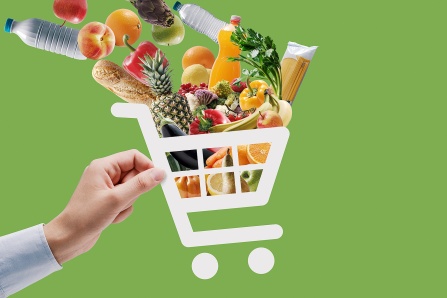
NIH funds a $4 million study at UB to find out
BUFFALO, N.Y. – A University at Buffalo research team is launching a study to find out if preloading online grocery carts with healthy ingredients can improve the diets of families with young children at risk for obesity.
Funded by a $4 million grant from the National Institute for Diabetes and Digestive and Kidney Diseases of the National Institutes of Health, the study is designed to test a new family-based approach to early obesity prevention that aims to make the healthy choice the feasible, appealing and easy choice.
Stephanie Anzman-Frasca, PhD, associate professor of pediatrics in the Jacobs School of Medicine and Biomedical Sciences at UB and director of its Child Health and Behavior Lab, is principal investigator.
Making healthy choices easier
“Research supports the idea that repeated exposures to nutritious foods can support children in developing healthy food preferences and dietary patterns over time,” she says, “but our modern food environment does not necessarily make it easy for families to provide those exposures. Our lab is interested in identifying and scaling effective ways of modifying modern food environments to make choosing nutritious foods more feasible, appealing and more automatic.”
The new research builds on a 4-week pilot study the UB team conducted with Instacart of families that had 2-to-5-year-old children at risk for obesity. The findings showed that healthier choices can be supported by making them easier and more automatic, a demonstration of the concept of “optimal defaults.” Anzman-Frasca and her team at UB have also conducted pioneering work demonstrating this concept with adults.
“Leveraging optimal defaults – in this case making healthy choices more automatic by prefilling online grocery carts with healthy ingredients while still giving families the autonomy to opt out – shows a lot of promise,” she says.
The pilot study found that when families were provided with healthy recipes and their online grocery carts were preloaded with the ingredients to make those recipes their purchases were significantly more nutritious compared to a group that received only the recipes. Families paid for their grocery purchases as usual and were free to alter their carts as they liked, with most participants in the prefilled cart group accepting at least some of the recipe ingredients placed into their carts.
“The fact that this optimal defaults intervention worked for families with young children was exciting, given that we know children in this age group can be hesitant to try new foods,” says Anzman-Frasca.
First large-scale online grocery shopping study of its kind
The new study is the first time optimal defaults will be studied on a large scale with families’ online grocery shopping. Approximately 200 families will be recruited, all of whom will receive healthy recipes that meet nutritional criteria from the Traffic Light Diet, an evidence-based diet developed at UB for family-based obesity prevention and treatment. Half the families will also receive online grocery carts prefilled with the necessary ingredients to make those recipes.
Given that dietary restrictions and food preferences vary, the researchers have been working on an expanded recipe bank, to allow the provided recipes to be tailored to families’ food preferences.
“We focused on identifying and adapting recipes that are simple, affordable, nutritious and customizable to address factors like time constraints, food costs and pickiness, which can make healthy eating challenging for families in today’s food environment,” says project coordinator Jack McGowan.
Provision of recipes and prefilled carts will continue for six months during the study, with follow-up assessments on the nutritional quality of groceries purchased at six and 12 months.
“In addition to assessing grocery purchases, our new study includes measures of parent and child dietary intake and weight outcomes, allowing us to test whether targeting grocery purchases impacts these health metrics over time,” Anzman-Frasca explains.
Because children are still growing, and because families are being recruited whose children are at risk for obesity but not necessarily presenting with obesity now, child weight loss is not an outcome they will be evaluating. Instead, height and weight will be monitored over time to observe healthy, age-appropriate growth.
Assessing the impact
Anzman-Frasca notes that the researchers will evaluate what children and families are consuming based on the Healthy Eating Index, (HEI) a dietary rating system that encourages greater consumption of food groups like fruits, vegetables, whole grains and protein, and lower consumption of refined grains, sodium and added sugar.
“A diet that adheres to this rating system is associated with many health benefits besides healthy weight,” she continues, “and exposing children to foods encouraged by the HEI can also support healthier dietary patterns as they grow, given evidence that repeated exposure to nutritious foods like vegetables can support vegetable acceptance and intake over time.”
The economics of healthy eating
An interesting result of the researchers’ pilot study was that grocery spending went down in both groups even though this wasn’t a goal of the study. The researchers will examine how much families spend throughout the new study. Both the healthy recipes and the prefilled carts are designed to be low in cost, adhering to budgetary guidance from the U.S. Department of Agriculture’s Thrifty Food Plan.
Recruitment of families for the new study began this month and is ongoing. More information is available on the lab’s Facebook page: www.facebook.com/ubhablab.
Leonard H. Epstein, PhD, SUNY Distinguished Professor in the Department of Pediatrics at the Jacobs School, who developed the Traffic Light Diet, is co-investigator, along with Lucia A. Leone, PhD, associate professor in the Department of Community Health and Health Behavior, and Gregory Wilding, PhD, professor in the Department of Biostatistics, both in the UB School of Public Health and Health Professions. Corby Martin, PhD, of Pennington Biomedical Research Center and Mackenzie Ferrante, PhD, of Rutgers University, are also co-investigators.
The Independent Health Foundation is a community collaborator on the project, contributing nutritional expertise and recipe ideas from their Healthy Options at Home program. The University at Buffalo Civic Engagement Research Fund supported recipe bank development for this project.