
Come Together, Right Now: Why Live Music Benefits Well-Being
By Bert Gambini
Don’t pass up those concert tickets. There might be more to the show than just great music. In fact, attending live music events can have lasting, meaningful effects on listeners’ well-being, according to a new study by researchers at the University at Buffalo.
Researchers have long recognized the positive effects of music on listeners, but what exactly generates those feelings of well-being, particularly in the context of live events, remains unclear. The current UB paper offers new insights suggesting that the effects are not derived entirely from what the musicians give to the audience, but also what the audience unwittingly shares amongst themselves.
This is collective effervescence (CE), and it has an important role in concert settings.
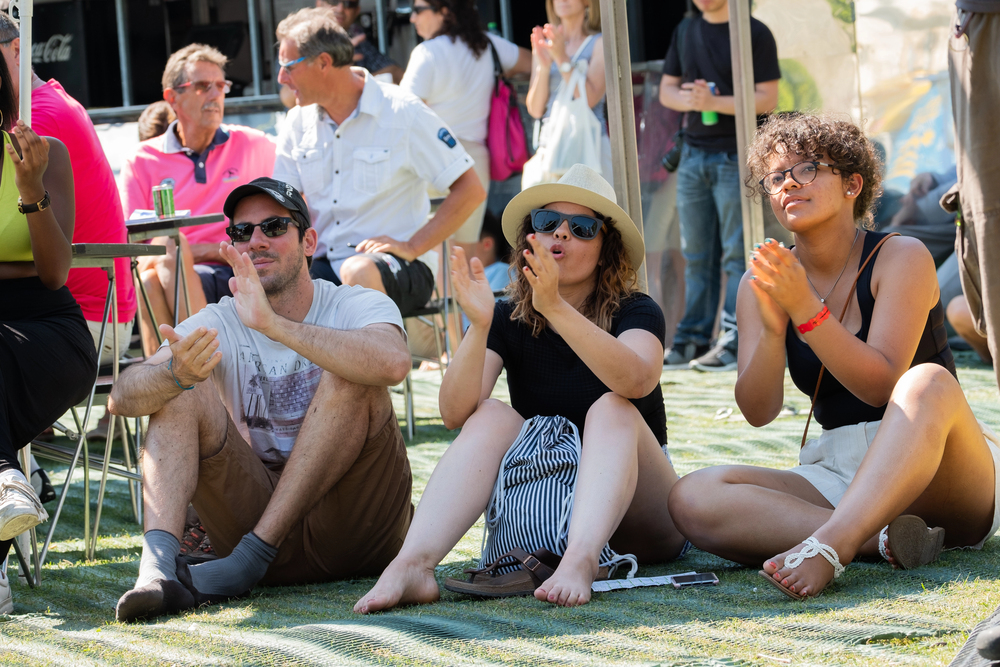
CE describes a combined sense of connection to others and of sacredness felt by people in a crowd, engaged in a shared experience such as a live musical performance.
“Across the board, in all four studies we conducted for this paper, collective effervescence consistently emerged as a strong predictor of well-being,” says Nicole Koefler, a doctoral candidate in the UB psychology department and the paper’s corresponding author. “Our evidence suggests that one of the reasons listeners benefit so much from attending live music events is because of that feeling of collective effervescence,” she adds. “It builds off our need as social beings to be connected to others and to be connected to something perhaps larger than our day-to-day lives.”
The results appear in the most recent issue of the journal Personality and Social Psychology Bulletin. Koefler and the study’s co-authors used both university and community samples for their paper. Across the four studies, the number of participants ranged from roughly 130 to 180, with one study using a sample size of 290. The researchers collected survey data and information from people who had recently attended music festivals.
The first two studies established the close link between CE and music and found that CE explained the positive outcomes people report from attending live music events. The final two studies replicated those findings and suggested that the positive effects didn’t end with the music, but could linger for days. The paper examined only music performances and the role of CE, but Koefler notes that CE can be experienced nearly any time people come together for a shared experience. “This means there can be a lot of opportunities for increasing well-being beyond live music,” says Koefler, who recently attended a concert by a classically trained harpist.
And how was the experience? “I definitely felt what was written about in this paper,” she says. “I think people should use this research as an invitation to go out and celebrate with people. Seek opportunities to connect.”
Bert Gambini is a News Content Manager for UB’s social sciences, humanities, and School of Social Work.