New Hearing Loss Test Examines the Eyes – Not the Ears
by Annette Pinder
Hearing loss among older adults is linked to cognitive decline, an increased risk of Alzheimer’s disease and other dementias, as well as depression and social isolation. Yet most older adults do not receive regular hearing checks, often because they lack access to audiological services or are reluctant to admit they may have a hearing problem. Even if someone experiencing cognitive decline takes a hearing test, the results may be inconclusive because the patient might not fully understand the instructions.
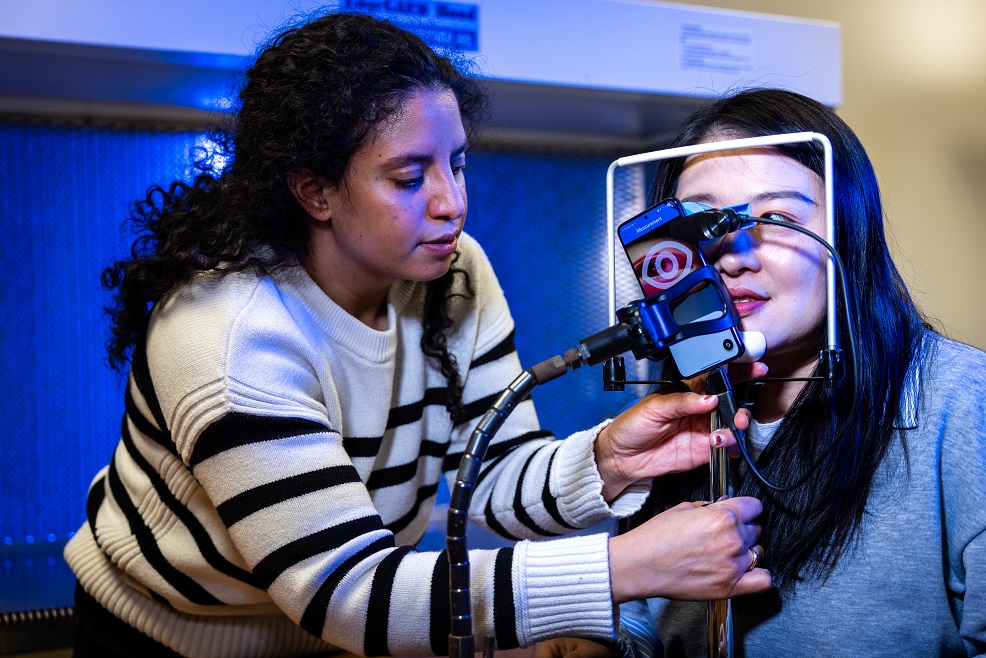
Auspex Medix, a UB spinout company, is tackling these challenges with a new hearing test that measures how a patient’s pupils involuntarily change size in response to sound. Auspex Medix founder Wenyao Xu, PhD, professor of computer science and engineering at the University at Buffalo School of Engineering and Applied Sciences, says, “Hearing loss is a widespread and often overlooked public health threat that can worsen cognitive and functional decline. To address this, we’re creating a low-cost, AI-powered tool that older adults can use at home to determine if they need further medical care.” Auspex Medix received a $252,550 grant from the National Institute on Aging to advance the technology.
Neuroscientists, psychologists, and other researchers have studied how pupils respond to sound—sometimes called the pupillary light reflex or auditory pupil response—for decades. However, Xu believes this is the first time it has been used as a potential biomarker for hearing loss. The hearing test combines a smartphone with a custom clip-on pupillometer that measures the user’s pupils as a series of sounds plays from an app. This data is then processed by software on the smartphone, including deep learning algorithms, for analysis.
The test does not require active participation from the user, says co-principal investigator Wei Sun, PhD, an associate professor in UB’s Department of Communicative Disorders and Science. Xu and Sun will collaborate with researchers from Dent Neurologic Institute to enroll older adults, including participants with mild cognitive impairment, mild Alzheimer’s disease, or related dementias, to evaluate the test.
Auspex Medix received funding from UB’s Center of Excellence in Bioinformatics and Life Sciences (CBLS) and operates out of the Incubator at Baird, a space near UB’s North Campus. Auspex Medix will also receive funding from the UB Center for Advanced Technology in Big Data and Health Sciences, a BEP-managed grant program supported by Empire State Development’s Division of Science, Technology, and Innovation, to match its National Institute on Aging funding. Auspex Medix also received BEP support for filing patent applications and employs student assistants through BEP’s Career Experience Program. Xu plans to improve the test’s robustness, lower its cost, and make it more user-friendly.
“If we can detect hearing loss early, we have a better chance of addressing, and possibly slowing, cognitive decline and other issues such as social isolation, depression, increased fall risk, and Alzheimer’s disease and related dementias,” Xu says.
Photo Credit:
Credit: Meredith Forrest Kulwicki, University at Buffalo