
On Earth Day, UB announces major milestone in carbon neutrality goal
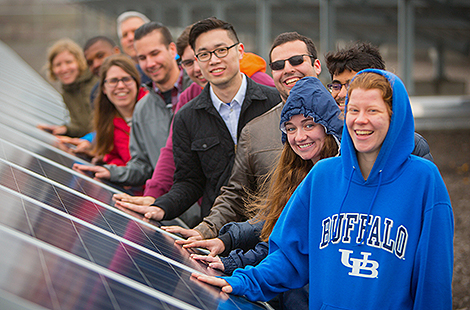
BUFFALO, N.Y. – Today, on Earth Day, University at Buffalo President Satish K. Tripathi announced that UB has achieved its carbon neutrality goal for its directly controlled emissions — five years ahead of schedule. It’s a milestone that reflects decades of collective vision, innovation and commitment to campuswide change.
“On Earth Day 2026, I am delighted to share a major milestone in our climate action plan: The University at Buffalo has achieved climate neutrality for the emissions we directly control,” Tripathi said.
“In simple terms, this means that the energy that powers our campus, and the fuel that supports our operations, now have a net-zero greenhouse gas impact on the climate,” Tripathi added. “This milestone reflects years of commitment, innovation, and shared effort across our campus community. It also represents a meaningful step forward in our journey — to take responsibility for our emissions, drive climate solutions, and prepare the next generation of leaders to build a more sustainable future.”
In 2020, UB unveiled its most ambitious Climate Action Plan (CAP) update. With that plan, the university renewed the commitment it made in 2007 — when UB signed on to the American College and University Presidents’ Climate Commitment — to achieve climate neutrality by 2030. That’s the year UB’s own scientists and others say is the deadline to stave off more severe global warming and the worst impacts of climate change.
In achieving this goal, UB is generating zero net greenhouse gas emissions for its directly controlled emissions, often referred to as Scope 1 and Scope 2. Scope 1 emissions are generated from the burning of natural gas to heat campus buildings and include fueling the university’s vehicle fleet, while Scope 2 refers to emissions from electricity purchased.
UB achieved its goal through a combination of energy efficiency and decarbonization activities that resulted in the university reducing its greenhouse gas emissions by 66% since 2007.
UB has also made substantial investments in energy efficiency, decarbonizing its campus heating sources, converting its vehicle fleet to electric, and generating renewable energy both on- and off-campus. These strategies have been combined with the purchase of high-quality super-pollutant carbon credits created by activities that capture and eliminate greenhouse gas emissions.
“This milestone shows what is achievable when sustained commitment, thoughtful planning, and strong institutional leadership unite in service of climate action,” says Tim Carter, president of Second Nature, an organization that works to accelerate climate action in and through higher education.
“Second Nature is proud to support the University at Buffalo and our broad network of higher education institutions as they move from ambition to tangible, measurable impact,” Carter adds. “Achieving climate neutrality for directly controlled emissions five years early sets a compelling example for higher education institutions across the country and reinforces the vital role higher education plays in advancing climate solutions at the speed and scale this moment requires.”
The road to neutrality
UB’s path to carbon neutrality is centered around the university’s climate action plan, called UB’s 10 in 10, a roadmap of innovative, engaging and digestible steps to increase the university’s climate action and put UB on a path to net zero emissions by 2030.
These initiatives represent a synthesis of ideas expressed by a diverse array of stakeholders through a robust campus engagement process.
A foundation of UB’s strategy was transitioning to renewable electricity. The university now generates and purchases 100% of its electricity from clean sources, which has led to an approximately 30% decrease in UB’s overall carbon footprint. This has been achieved through direct on-site solar, off-campus solar generation and the purchasing of renewable energy credits.
In addition, UB completed comprehensive clean energy master plans for the North, South and Downtown campuses, creating a roadmap to converting outdated, inefficient, fossil-fuel burning heating systems.
Read more about UB’s path to achieving carbon neutrality for directly controlled emissions on the UB News Center website.
Eliminating super-pollutants
All told, UB’s decarbonization activities add up to the elimination of 66% of its direct emissions.
“That’s substantial, but achieving the next 34% will take significant time as implementing the clean energy master plans requires addressing 13 million square feet of buildings and the capital required to renovate them,” says UB Chief Sustainability Officer Ryan McPherson. “This is why the university is leveraging other key strategies to complement the decarbonization work and fulfill our promise as well as provide direct impact in lowering emissions.”
Last April, UB announced it was the first State University of New York (SUNY) institution to purchase high-quality carbon credits as part of its comprehensive climate neutrality strategy.
This year, UB has partnered with Tradewater, a certified B corporation that collects, controls and permanently prevents the release of super-pollutants like ozone-depleting substances (ODS), on the purchase of 42,100 credits from Tradewater’s ODS 10 project.
UB’s funding ensures that Tradewater can reach and safely destroy equipment and canisters that hold legacy ozone-depleting substances and which are at risk of leaking super-pollutants into the atmosphere. The move places UB among an elite group of universities that are purchasing high-quality carbon credits that target the safe destruction of ODS.
Why now?
UB’s own world-renowned climatologists, along with others, have emphasized the importance of reducing greenhouse gas emissions to keep warming below 1.5 degrees Celsius.
That’s why today’s announcement is a critical one, according to UB officials.
“The science is clear: Achieving climate neutrality now is both scientifically sound and urgently necessary. While direct decarbonization must always be the cornerstone of climate action, we cannot afford to wait for these projects to materialize on their own — we must take action ourselves,” write members of UB’s Climate Science Research Group in the Department of Earth Sciences, College of Arts and Sciences.
The group includes Jason P. Briner, Yifan Cheng, Beata Csatho, Stuart Evans, Sophie Nowicki, Kristin Poinar and Elizabeth K. Thomas.