Fighting for the Future of Medical Care in New York
UB Medical Students Advocate for Access to Medical Education
By Benjamin Semegran, Sanjida Riea, and Annette Pinder
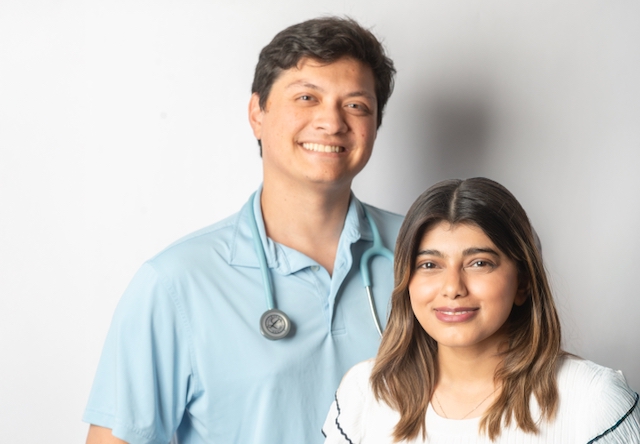
When Sanjida Riea arrived in the United States from Bangladesh in 2019 at age 18, she brought with her a dream of becoming a physician. After losing an aunt to an aneurysm, she became determined to pursue neurosurgery, conduct research, and help prevent strokes and aneurysms. “I am the first in my family to attend high school, college, and medical school,” says Sanjida. “But with medical school costs averaging about $80,000 per year, talented students who are not wealthy cannot attend medical school without access to federal student loans.” Sanjida is committed to advancing research, expanding access to quality care, and advocating for patients, peers, and communities.
Benjamin Semegran’s path to medicine was different, but his concerns are similar. His mother immigrated to the United States from Vietnam at age six and later became an ophthalmologist. “My mom was able to attend medical school because of federal loans,” says Ben. “Without that opportunity, her career might not have been possible.” Ben’s father is a general surgeon, and discussions about healthcare were a regular part of family life. Those conversations became even more meaningful when Ben was diagnosed with cancer during high school. Ben still receives care to live a normal life after his cancer, which, despite deeply understanding the system, is often delayed. “My experiences make me determined to be a physician and advocate,” says Ben. “I want to help improve systems that don’t work for everyone, especially people struggling to access care.”
Today, both students are advocating for an issue they believe could affect the future of healthcare. According to Ben, the passage of House Resolution 1 (HR1), known as the One Big Beautiful Bill, changed how graduate students can finance their education. One provision eliminated a federal graduate loan program and shifted many students toward more expensive unsubsidized loans. For medical students, the consequences could be significant. Many may be forced to choose between taking on higher-cost private loans and reconsidering their decision to attend medical school altogether. The timing is especially concerning given the growing physician shortage facing the nation.
According to the Association of American Medical Colleges, the United States could face a shortage of up to 40,400 primary care physicians within the next decade. New York is projected to need more than 1,200 additional primary care physicians by 2030 simply to maintain current levels of care. At the same time, rural communities continue to struggle with access to healthcare and physician recruitment. Students worry that rising financial barriers could disproportionately affect first-generation, lower-income, and minority students, reducing the diversity of the physician workforce and making it less representative of the communities it serves.
In response, affected UB students launched an advocacy campaign to find solutions. “Advocacy is an exhausting process that requires time, money, and willpower,” Ben and Sanjida explain. “Successfully introducing legislation requires coalition building, policy development, research, and communication with community leaders and legislators. The effort involves organizing volunteers, developing messaging, gathering data, seeking funding, and educating lawmakers. At the same time, student advocates must balance the demanding workload of medical school. Effective advocacy requires getting the right message to the right people,” they say. “Students spend countless hours identifying community leaders who can help guide these efforts and legislators who can champion meaningful change.”
Despite the challenges, their work has already produced encouraging results. Student advocacy efforts led to the introduction of a proposed New York State loan program to supplement the loss of federal funding. Another proposal would freeze SUNY tuition at the rate students pay when they first enroll, helping provide greater financial predictability throughout medical school. While both initiatives still face hurdles, including approval by the New York State Senate, the students remain optimistic.
Kenneth V. Snyder, MD, UB professor and neurosurgeon, encouraged the students to share their story and believes the issue extends beyond individual students. He says, “We need to ensure that medical students don’t graduate with massive debt that limits their career choices because they are focused on repaying loans. We also need financial aid offices to do a better job helping students navigate their options. Most importantly, we must ensure that talented students don’t have to give up their dreams because they cannot find affordable financing.”
Both Benjamin and Sanjida are third-year medical students at UB. While they come from different backgrounds, they share a common belief that access to medical education should not depend on wealth. They say, “It’s important for people to hear from students like us. If we don’t speak up, no one else will.”