
Finding a Cure for Yuna: An Extraordinary Mom and Dad
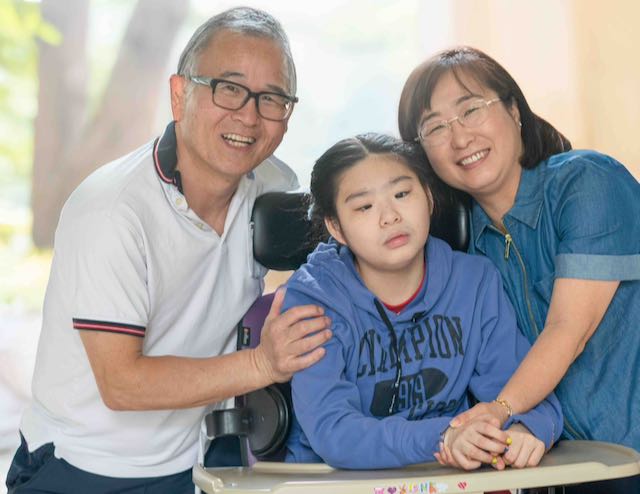
By Annette Pinder
Jae Lee and Soo-Kyung Lee were both born in South Korea, met at the same school, and married in Texas in 2005. Having pursued their studies in different cities in the United States, including Portland, San Diego, and Houston, they say Buffalo is their favorite. Jae Lee, PhD, is a professor in the UB Department of Biological Sciences and principal investigator of the FOXG1 Research Center at the University at Buffalo (UB). Soo-Kyung Lee, PhD, is a SUNY Empire Innovation Professor and Om P. Bahl Endowed Professor in the UB Department of Biological Sciences and director of the FOXG1 Research Center.
Yuna, their daughter, was born in January 2010 after a normal pregnancy, but a three-week checkup revealed that her head circumference was far below average. Seeking answers, a San Francisco physician who reviewed Yuna’s MRI suspected FOXG1 syndrome. However, Yuna’s neurologist in Portland had never heard of it, and the Lees didn’t receive her devastating diagnosis until three years later, after a FOXG1 screening.
FOXG1 syndrome is a rare, severe neurodevelopmental disorder caused by mutations or deletions in the FOXG1 gene. Because this gene is critical for early brain development, the syndrome disrupts brain development, causing microcephaly (small head size), profound intellectual disability, and severe physical and neurological symptoms. While every individual with this mutation experiences FOXG1 syndrome on a spectrum, the most common features include severe developmental delays (inability to sit or walk independently and lack of speech); movement disorders; epilepsy; structural brain abnormalities; autism-like traits; and difficulty feeding. FOXG1 syndrome is not typically inherited.
Today, Yuna is 16 and 100% dependent. “Someone must be with her all the time. She can’t walk, talk, or feed herself, has no motor coordination, but can sit. She has strong muscle tone, but can’t control or use her muscles. Despite being the most disabled person, she loves school. A sweet and happy child, Yuna loves listening to her brother Joon, an excellent musician, play music for her. Also, despite being highly autistic, she loves social interactions, is constantly touching us, and we all know what she wants. While many children with FOXG-1 are unable to eat or taste food, Yuna loves food, especially pasta.” Jae, who loves to create culinary delights for the family, says, “Mealtimes are a favorite for all of us.”
The most remarkable aspect of this story, however, is the path the Lees followed after Yuna’s diagnosis. “Up until then, we were workaholics. After that, our devastation gave way to a determination to find a cure for her. We also wanted to have more children, as family is so important to us.”
As it turns out, Yuna could not have been born to more perfect parents, as Jae and Soo were specifically trained in Transcription Factors (TFs). TFs are proteins that bind to specific DNA sequences to control gene expression. When mutated or dysregulated, they disrupt gene networks, leading to a wide range of conditions—from cancers and metabolic disorders to immune system defects. Both Soo and Jae had this specific expertise.
Jae explains, “Everyone has two copies of the FOXG-1 gene, and both play a vital role in brain function. However, Yuna has only one functional FOXG-1 gene. If neither of her genes worked, she would not be alive.”
So, what did the Lees research involve? What was their discovery? The Lees knew that mice also have two copies of the FOXG1 gene, so they mutated one of the mice’s genes to mutations found in human patients. As they suspected, the mice developed FOXG1 syndrome. They then delivered a working copy of the FOXG1 gene into each of the mice’s brains. Knowing that each mutation produces a different set of symptoms, the Lees created multiple mouse models. Amazingly, the different mouse models were successful, and the mice recovered after receiving the healthy gene! In fact, the mice started speaking again—yes, mice can speak.
The FDA fast-tracked the therapy discovered by the Lees, and the first in-human clinical trial has been conducted, with 12-20 more to follow. All of this was made possible by the FOXG1 Research Foundation, through its “Yes, They Can” campaign. The foundation is believed to be the first parent-led, nonprofit organization for a rare disease to independently sponsor its own multi-site, international gene therapy trial.
“As both scientists and parents of a child with FOXG1 syndrome, this milestone is very personal to us,” says Jae. “It brings hope not only for our daughter but also for all children and families affected by this devastating neurodevelopmental disorder, as well as other conditions, like autism, and other diseases.”