Twice as Rare: Meet Gabriella and Juliana Gonzalez
February 2026 Cover Story
Juliana Gonzalez will be featured at the American Heart Association Go Red for Women Luncheon
by Annette Pinder
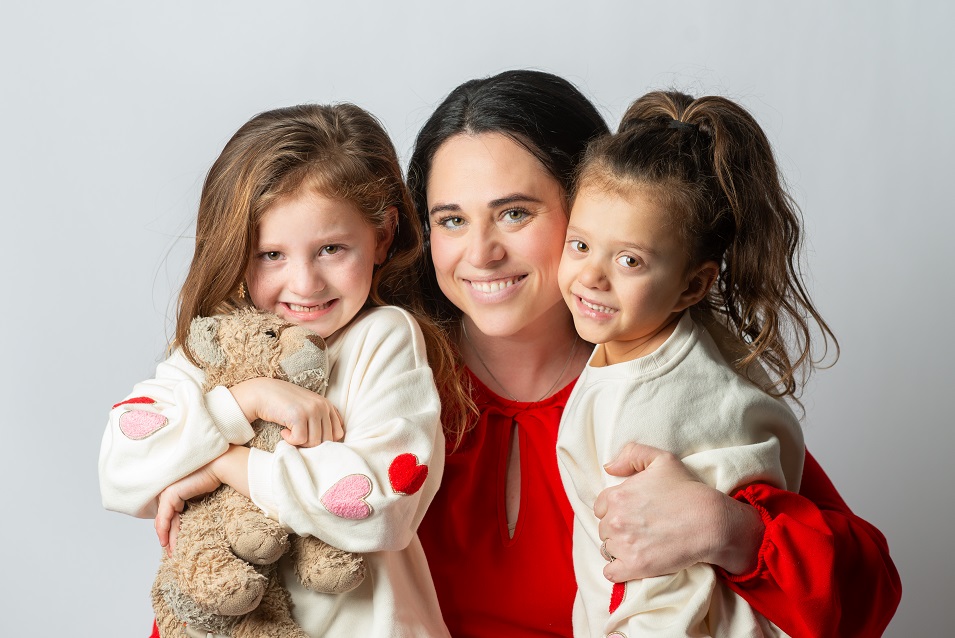
Six-year-old Gabriella and Juliana Gonzalez are perfect choices for our February cover story as we observe both Rare Disease Day and American Heart Month. Gabriella and Juliana are fraternal twins, each battling rare illnesses. Gabriella has infantile digital fibromatosis, and Juliana, who has pulmonary valve stenosis and an atrial septal defect caused by Noonan Disease, is being honored at this year’s American Heart Association Go Red for Women Luncheon.
One thing that is not rare in Western New York is the close-knit nature of our small community, where one degree of separation is often the norm. This story is no different. It turns out that Gabriella and Juliana’s mom, Kristen, attended Country Parkway Elementary and Transit Middle School in Williamsville — just like my daughter — and was also in my Girl Scout troop.
Despite speaking with Kristen several times in her role as Marketing Director at Villa Maria College, I didn’t know about her family or her twins. I knew she was a mom of four, a wife, and a busy professional, but I had no idea how busy she really was. “My life sometimes feels like 24/7 chaos, but my husband Andrew and I have a routine now, and we manage,” she says.
Kristen’s pregnancy was normal, and the twins were born via C-section at 37 weeks. Gabriella weighed 4 pounds, 4 ounces, and Juliana weighed 4 pounds, 14 ounces. There were no signs of problems at birth; however, during Juliana’s first checkup, her pediatrician detected a heart murmur and referred her to Pediatric Cardiology Associates in Buffalo.
Dr. Glen Leonard, who cares for Juliana at Pediatric Cardiology Associates, determined that she had a hole in her heart and a narrow valve impeding proper blood flow. He also referred Juliana to Dr. Laurie Sadler, a geneticist, to confirm his suspicion that Juliana might have a genetic disorder called Noonan Syndrome, often associated with this condition. Juliana’s diagnosis of pulmonary valve stenosis and an atrial septal defect refers to her pulmonary valve, which is too narrow, located between her right ventricle and the pulmonary artery, which leads to her lungs. She was also confirmed to have Noonan Syndrome, caused by a mutation in the PTPN11 gene, which also affects her cell growth.
Juliana underwent a balloon procedure to open her valve, but will likely need open-heart surgery in Rochester when she reaches 50 pounds. Kristen says, “She is small, weighs just 35 pounds, and finally made it into the first percentile for her age group. Many babies like Juliana don’t even make it, and if they do, they may suffer from severe hearing and vision loss, and are at a higher risk for kidney problems and leukemia. Juliana is very high-functioning and has never felt different from any other normal child. She does have a harder time walking and keeping up physically with kids her age, tires easily, and isn’t very coordinated. It’s not uncommon for Juliana to veer off into a wall. Even eating is exhausting. She can’t finish a meal of chicken nuggets in one sitting,” says Kristen.
Meanwhile, Juliana’s twin, Gabriella, has infantile digital fibromatosis, which causes multiple benign tumors to develop on her fingers. Although rare, it affects both males and females, and the fibromas can grow up to 2 cm. In Gabriella’s case, they interfered with her ability to use her hands, necessitating their removal at Boston Children’s Hospital. Since many fibromas can resorb and disappear naturally over 2 to 3 years, they hope this will happen with Gabriella. “The biggest challenge has been understanding the medical,” says Kristen. “Most health providers don’t know people with these conditions, and have to learn about them. So, people line up to see Gabriella for her visits to Boston Children’s Hospital. We also don’t know what the future holds. But we are grateful for the medical innovations and treatments available today, including the possibility that growth hormone may eventually assist in Juliana’s growth.”
“The girls behave like any other 6-year-olds. They get along until they don’t, fight over the remote, and argue about each other’s clothes. Gabriella enjoys creative arts, while Juliana loves reading, math, and gymnastics, where her small size gives her an advantage. Although Gabriella is stronger, it was Juliana who learned to ride a bike first, out of sheer determination,” says Kristen. With two other children—a 3-year-old girl and an 8-year-old boy who plays travel hockey—and their dog Duke, Kristen and Andrew enjoy playing pickleball, getting the kids where they need to go, and letting the little one tag along.